IconquerClient: A Cross-Platform Swift Networking Client Built for Modern Apple Ecosystems
iConquer
3 min read
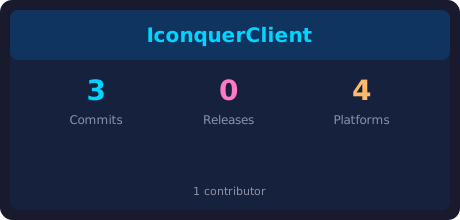
In roughly two weeks and three focused commits, a lean Swift package took shape — bringing structured networking and async I/O to macOS, iOS, tvOS, and visionOS under a single, well-tested library target.
Problem
Networked applications across Apple’s platform family often repeat the same boilerplate: connection management, logging integration, async coordination. When the Iconquer ecosystem needed a dedicated client library, the goal was to build something reusable and portable — not another one-off networking layer buried inside a single app target. The challenge was delivering a clean abstraction over Swift NIO’s event-driven I/O that felt natural to Swift 6 consumers across every relevant Apple platform.
Approach
The library was structured as a focused Swift Package Manager package, targeting Swift tools version 6.2 and declaring explicit platform support for macOS, iOS, tvOS, and visionOS from the outset. Rather than writing a bespoke I/O layer, the project reached for swift-nio as the async networking foundation — a deliberate choice that trades a lighter dependency footprint for production-grade event loop management and connection handling without reinventing low-level primitives.
Alongside swift-nio, swift-log was brought in as the observability backbone. Tying log output to the standard Swift logging ecosystem means consumers can route IconquerClient’s diagnostic output through their own logging handlers — a small but meaningful integration point for library users who care about operational visibility.
Documentation was treated as a first-class concern from the start: the inclusion of swift-docc-plugin signals an intent to ship developer-facing docs as part of the build pipeline, not as an afterthought.
The package is organized into two targets — IconquerClient and IconquerClientTests — keeping the production surface clean and the test boundary explicit.
Results
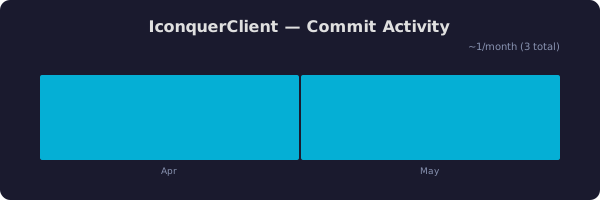
Over a 13-day development window spanning late April to early May 2026, the library landed across three commits on a single focused branch. The dual-target structure is in place, cross-platform declarations are established, and the dependency graph is locked to three well-maintained Swift open-source packages. The library is positioned for consumption by any Apple-platform application that needs to communicate with Iconquer services, with a public API ready to be documented via DocC.
Judgment Calls
Several decisions here reflect library-authorship thinking rather than application-building instincts.
Choosing swift-nio over URLSession. For a library targeting all four Apple platforms, URLSession would have been the path of least resistance. Reaching for swift-nio instead suggests the client is doing something closer to the metal — likely persistent connections, custom protocols, or multiplexed I/O — where URLSession’s abstractions would have gotten in the way.
Adopting Swift 6 tooling immediately. Swift 6’s strict concurrency model is stricter to satisfy but produces libraries that are genuinely safer for consumers running their own actor-isolated or structured-concurrency code. Opting into tools version 6.2 early means IconquerClient’s public API is designed for Swift concurrency from day one, rather than inheriting the technical debt of an async retrofit.
Four-platform declaration upfront. Listing macOS, iOS, tvOS, and visionOS in the manifest before the library was fully built is a constraint that keeps cross-platform compatibility honest throughout development. It’s easier to declare broad support early and let the compiler enforce it than to bolt on platform support after the fact.
Documentation infrastructure on day one. Adding swift-docc-plugin in the initial dependency set rather than the final one is a subtle tell about working style — documentation isn’t a polish pass, it’s part of the definition of done.

Tagged with: iConquer, selfReflection