Building a Judgment Corpus Tool for Organizational Data
Internal Infrastructure
2 min read
A focused Swift utility for constructing and managing a corpus of labeled judgments, built and committed in under four minutes.
Problem
Evaluation pipelines and ranking systems live or die by the quality of their training signal. Without a structured, reproducible way to collect and store human judgments against organizational data, teams fall back on ad hoc spreadsheets or one-off scripts that don’t compose. The org-judgement-corpus project addresses the need for a dedicated tool to assemble and maintain a corpus of explicit judgments — the kind of labeled ground truth that powers relevance tuning, classification, and quality assessment workflows.
Approach
The project is implemented in Swift, positioning it within a native macOS or command-line tooling context where performance and type safety matter for data integrity work. The choice of Swift for a corpus management utility reflects a deliberate preference for compiled, statically typed tooling over interpreted alternatives — a tradeoff that favors correctness and long-term maintainability over rapid prototyping convenience.
The repository was established with a clear directory structure under a dedicated Tools grouping within a broader Swift development workspace, suggesting this is one instrument in a larger organized toolkit rather than a standalone experiment.
Results
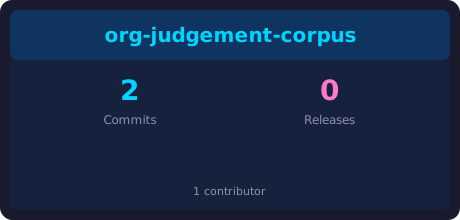
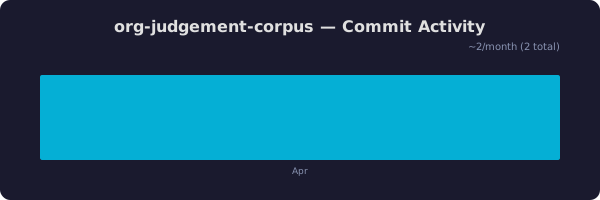
The project reached an initial committed state in approximately four minutes — from first commit at 23:08 to second at 23:11 on April 28, 2026. Two commits represent the scaffold: the project standing up and an immediate follow-on refinement, which is a recognizable pattern for a developer who commits early and iterates rather than holding work locally. The repository is on a single branch, consistent with a tool at its founding stage, not yet requiring feature branching.
Judgment Calls
The most telling decision here is the decision to build at all. Reaching for a dedicated, versioned, compiled Swift tool for corpus management — rather than a Python notebook or a CSV — signals that the developer treats evaluation infrastructure as first-class software. Judgment corpora are often the unglamorous scaffolding behind machine learning and search quality work; giving that scaffolding a proper home in a typed language with its own repository is an architectural opinion, not a default.
The placement under Tools within a structured Swift workspace also reflects a broader philosophy: individual utilities belong in a coherent ecosystem, making them discoverable and reusable rather than buried in project-specific directories. Even at two commits, this project carries evidence of a developer who thinks about where things live before they think about what they do.
Tagged with: org-judgement, infrastructure, selfReflection