QualityGateTypes: Shared Type Foundation for a Quality Gate Ecosystem
QualityGateTypes
2 min read
A focused Swift package that establishes the common type vocabulary powering a macOS quality gate toolchain.
Problem
Distributed tooling systems live and die by the consistency of their shared contracts. When building a quality gate system across multiple Swift packages or executables on macOS, the temptation is to let types drift — duplicating definitions, diverging semantics, or coupling consumers too tightly to implementation details. QualityGateTypes exists to prevent exactly that. The challenge was establishing a single, authoritative source of truth for the domain types that every other component in the quality gate ecosystem would depend on.Approach
The package targets Swift 6.0, signaling a deliberate commitment to strict concurrency and the type safety guarantees that come with the modern Swift toolchain. The structure is minimal by design: a single library target,QualityGateTypes, paired with a
QualityGateTypesTests target to validate the contracts from the start.
By isolating types into their own package, the architecture enforces a clean dependency graph. Consumers depend on definitions, not implementations — a foundational separation of concerns that keeps downstream packages loosely coupled and independently evolvable. This is a classic shared-kernel pattern, applied to a macOS developer toolchain.
Results
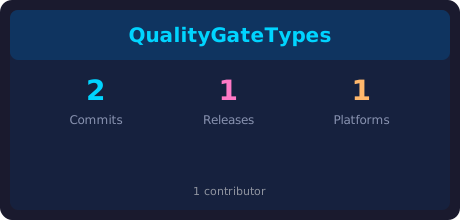
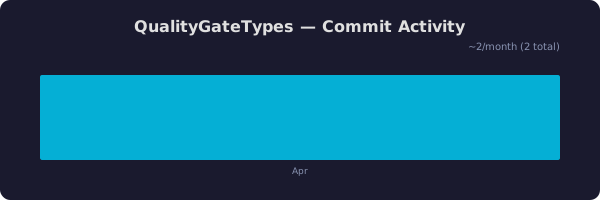
Version 1.0.0 shipped the same day work began — April 28, 2026 — with the entire package conceived, implemented, and released within minutes. Two commits captured the full arc from initial scaffold to tagged release. The package is live on a single stable branch, with no uncommitted drift from what shipped.Judgment Calls
The most telling decision here is what was not built. With zero design proposals and no iterative session history, QualityGateTypes reads as a package whose scope was settled before a line was written — the kind of clarity that only comes from understanding where a module sits in a larger system. Rather than folding types into a larger package and creating implicit coupling, the developer carved out a dedicated foundation layer.Releasing at 1.0.0 immediately, rather than sitting at a pre-release version, is also a signal: this isn’t exploratory code. It’s infrastructure meant to be depended on, and the version number communicates that contract stability is the point. For a shared-type package, that confidence matters — every downstream consumer is implicitly trusting this version boundary.

Tagged with: qualitygatetypes, selfReflection