Swift Security Rules: Laying the Groundwork for Automated Security Linting
swift-security-rules
2 min read
A newly initialized project signals intent to bring structured, automated security rule enforcement to Swift codebases.
Problem
Security vulnerabilities in Swift applications often slip through code review because reviewers must hold an enormous mental model of what constitutes risky patterns — unsafe force unwraps in authentication paths, improper cryptographic API usage, insecure data persistence, and more. Manual review doesn’t scale, and the Swift ecosystem has historically lacked the opinionated, security-focused static analysis tooling that languages like Go or Python enjoy. This project was started to address that gap directly.Approach
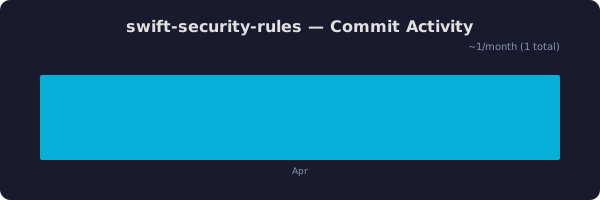
As of its initial commit on April 14, 2026,swift-security-rules is in its earliest stage — a single commit establishing the repository’s foundation. No design proposals have been formalized yet, and no automated tooling sessions have been logged. What exists is the decision to begin: a deliberate choice to carve out a dedicated tool rather than patch security checks onto an existing linter or bury them in a CI script.
The project lives within a broader Swift tools workspace, suggesting it will share infrastructure and conventions with adjacent work. The trajectory from here points toward defining a rule taxonomy, likely drawing on established secure coding standards for Apple platforms.
Results
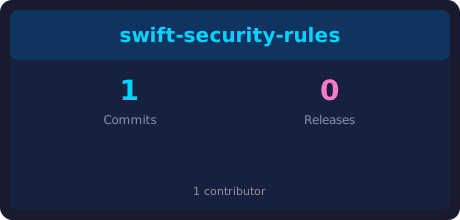
At this stage, the repository represents a commitment rather than a completed deliverable. One branch, one contributor, one commit. The work that ships next — rule definitions, test harnesses, integration hooks — will be built on this foundation.Judgment Calls
The most telling judgment call here is one of scope and separation. Starting a standalone repository for security rules rather than folding them into a general-purpose linting project reflects an understanding that security concerns deserve their own lifecycle, their own versioning, and their own focused maintainer attention. Security rules that live alongside style rules tend to get treated like style rules — opinionable, silenceable, low-stakes.By giving this its own home from day one, the project establishes that these rules are meant to be taken seriously. That architectural instinct — to separate concerns before the codebase grows complicated enough to make separation painful — is a pattern worth noting even when the commit count is still at one.

Tagged with: swift-security-rules, selfReflection