SwiftSVG: A Swift-Native SVG Toolkit for Apple Platforms
SwiftSVG
3 min read
A focused Swift package targeting macOS and iOS, laying the groundwork for first-class SVG handling without dependency on third-party rendering layers.
Problem
SVG support on Apple platforms has historically required developers to reach for WebKit, import heavyweight cross-platform libraries, or accept the limitations ofNSImage/
UIImage SVG rendering introduced only in recent OS versions. For developers who want fine-grained control over SVG parsing, manipulation, or rendering — whether for custom drawing pipelines, icon systems, or generative graphics — the native options remain thin. SwiftSVG represents an attempt to address this gap directly, in idiomatic Swift, with a library that feels at home in the Apple ecosystem.
Approach
The project is structured as a Swift Package Manager library targeting both macOS and iOS, built against Swift tools version 6.0. That choice signals intent: Swift 6’s strict concurrency model means any parsing or rendering work done here is being designed with data-race safety in mind from the outset, rather than retrofitted later. The package declares two targets —SwiftSVG for the library itself and
SwiftSVGTests for the test suite — establishing the separation between public interface and verification from the very first commit.
The repository exists in a personal development workspace nested under a structured local path, suggesting this is part of a deliberate toolkit investment rather than a one-off experiment.
Results
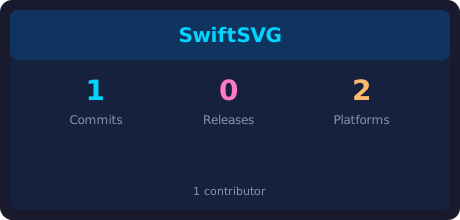
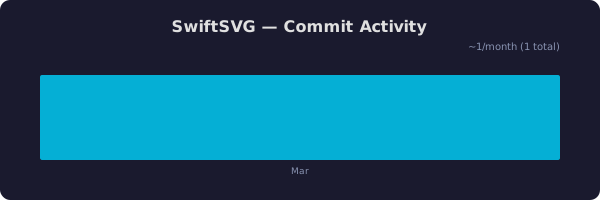
The project is at its earliest stage: a single commit on March 24, 2026 establishes the repository, package structure, and initial targets. No releases have shipped yet. What exists is a clean, intentional foundation — a Swift 6 package configured for the two most important Apple platforms, with a test target present from day one rather than added as an afterthought.That discipline — beginning with structure before substance — is itself a meaningful signal about how the project is being built.
Judgment Calls
Choosing Swift 6 tooling from the start. Swift 6’s concurrency guarantees are strict and, for new projects, occasionally demanding. Opting into them at initialization rather than defaulting to Swift 5 mode reflects a preference for correctness constraints over short-term convenience. SVG parsing involves potentially complex, multi-stage work that could benefit from structured concurrency, and making that bet early avoids painful migration debt later.Test target at commit one. The presence of SwiftSVGTests in the initial package definition — before there is any meaningful library code to test — reflects a test-first disposition. The scaffold exists so that writing the first test requires no structural decisions, only the work of writing the test itself. This is a small thing that compounds.
Platform targeting as a design statement. By explicitly targeting macOS and iOS, the package commits to AppKit/UIKit integration contexts rather than treating platform portability as a goal. This narrows scope usefully: the library can make assumptions about rendering environments, font handling, and coordinate systems that a fully cross-platform library cannot.
The project is a seed, not a harvest — but the choices made before the first line of library code are often the ones that determine whether a project grows into something trustworthy.

Tagged with: swiftsvg, selfReflection